
Did you know businesses can save up to 72% on EC2 costs simply by choosing the right pricing model? Reserved Instances (RIs) provide a smarter way for EC2 cost optimization spending through long-term commitment and substantial billing discounts.
Many AWS users start with On-Demand instances for flexibility and ease without upfront payments, but as usage grows, these can become costly. In contrast, by committing to consistent usage over one or three years, the Reserved Instances model allows organizations to lock in lower rates and achieve significant savings without compromising performance.
This blog explains what RIs are, outlines their types and payment options, and provides step-by-step instructions for purchasing them via the AWS Management Console.
What are AWS Reserved Instances (RIs)?
AWS Reserved Instances (RIs) are a pricing option in Amazon EC2 that allows organizations to commit to specific EC2 instance usage over a 1-year or 3-year term, in exchange for significant cost savings, up to 72% compared to On-Demand pricing. These savings vary based on factors such as instance type, region, term length, and payment method.
Reserved Instances are not actual EC2 instances. Instead, they are billing discounts that automatically apply when your running instances match the reservation’s defined parameters, such as instance type, region, and operating system.
Types of Reserved Instances
Reserved Instances come in two main types, each offering a balance between savings and flexibility:
1. Standard RIs
- Offer the highest discount (up to 72%).
- Less flexible as it is tied to specific instance attributes (family, region, OS, tenancy).
- Ideal for steady, predictable workloads.
2. Convertible RIs
- Provide lower discounts (up to 54%).
- Allow modifications to instance type, OS, or tenancy over the term.
- Ideal for businesses with evolving workloads that want cost savings.
Pricing Options
RIs can be purchased using one of three payment models:
- All Upfront: Pay the entire cost upfront and receive the maximum possible discount.
- Partial Upfront: Pay a portion upfront and the rest in monthly installments to balance savings with cash flow.
- No Upfront: No initial payment; pay monthly over the term with the lowest discount.
When to Use Reserved Instances (RIs)?
Reserved Instances are best suited for consistent, long-term workloads with predictable usage patterns, where cost optimization and planning matter. Common scenarios include:
- Long-running production servers (e.g., web, app, or database layers)
- Always-on applications and backend services
- Enterprises seeking budget predictability
- Workloads with well-understood capacity and regional requirements.
Prerequisites for Purchasing AWS RIs
- An active AWS account with the necessary IAM permissions (
ec2:PurchaseReservedInstancesOffering). - A clear understanding of the current EC2 usage patterns and long-term infrastructure requirements.
- Knowledge of the desired instance type, operating system, tenancy, and region.
- Budget availability for the selected payment option (All Upfront, Partial Upfront, or No Upfront)
Steps to Purchase Reserved Instances (RIs)
Step 1: Access the Reserved Instances Purchase Page
- Sign in to the AWS Management Console, navigate to the EC2 Dashboard, and select “Reserved Instances” from the sidebar.
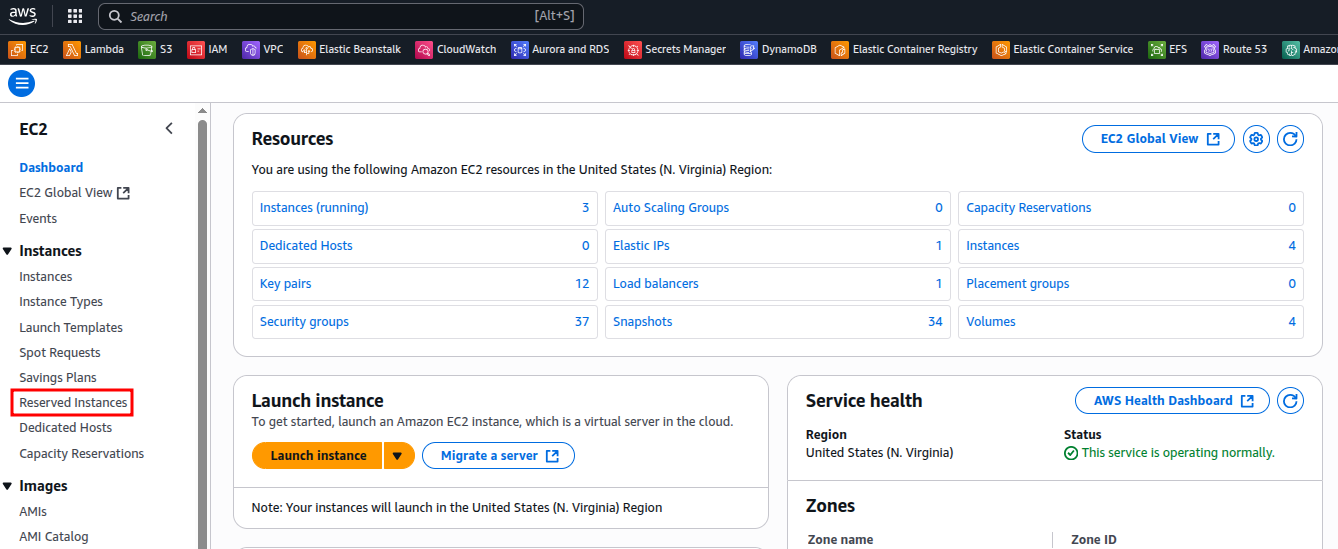
- On the Reserved Instances page, click Purchase Reserved Instances to begin configuring the reservation.

Step 2: Configure the Reservation Parameters
Specify the following settings based on workload requirements:
- Platform: Operating system (e.g., Linux/UNIX, Windows)
- Instance Type: The EC2 instance size and family to reserve (e.g., t3.medium, m5.large).
- Term: Commitment length of 1 or 3 years for discounted pricing.
- Offering Class: Choose between Standard (fixed) or Convertible (flexible) reservations.
- Tenancy: Default shared hardware or Dedicated physical servers.
- Scope: Regional or specific Availability Zone reservation scope.
- Payment Option: All Upfront, Partial Upfront, or No Upfront payment methods.
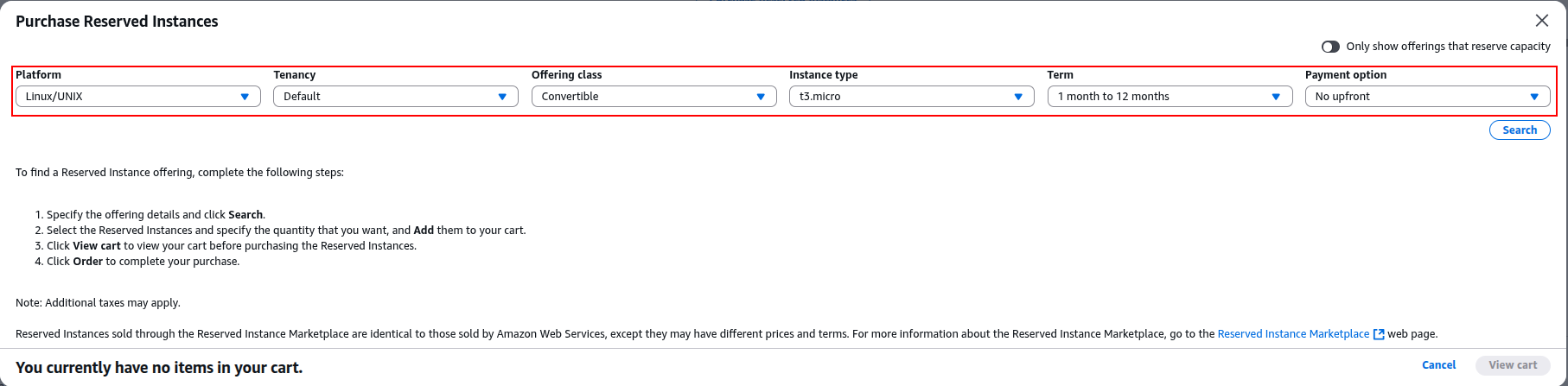
After entering these details, click Search to view matching Reserved Instance offerings and prices.

Step 3: Review and Add to Cart
After configuring an RI offering, click Add to Cart to queue the reservation. Multiple configurations can be added before finalizing the purchase.

Step 4: Final Review and Purchase
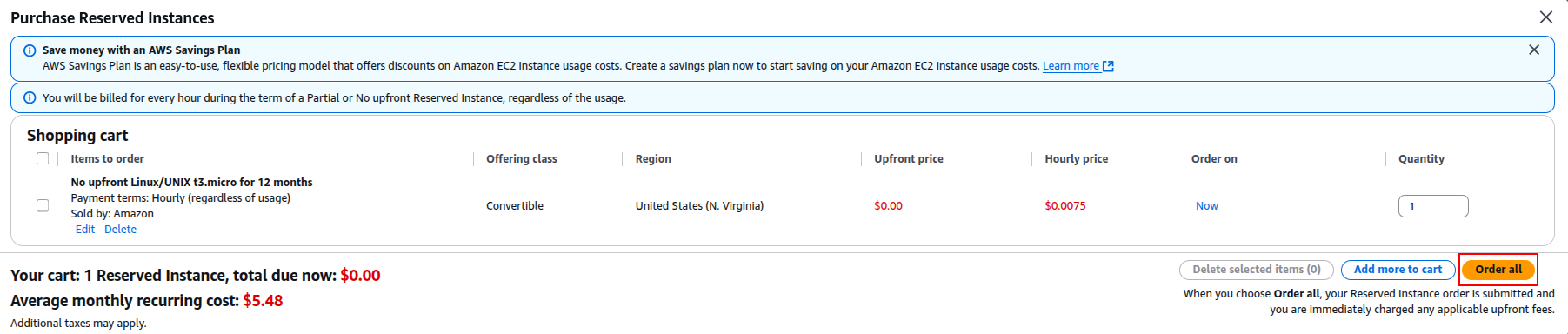
When all desired RIs are in the cart, open View Cart to review selections, then click Order All to complete the purchase.

Monitor Reserved Instance Usage and Utilization
After purchase, monitor Reserved Instances utilization using tools such as:
- AWS Cost Explorer → Reserved Instances: Provides utilization and coverage metrics for assessing RI usage.
- Reserved Instances Utilization Reports: Offers detailed information on RI consumption relative to running instances.
- AWS Budgets: Allows setting alerts based on usage or cost thresholds to notify when actual usage deviates from expected levels, enabling timely adjustments.
Ensuring that actual EC2 usage aligns with your reservation configuration is key to maximizing cost savings.
Best Practices for Using Reserved Instances
- Analyze usage patterns regularly using tools like AWS Cost Explorer and Trusted Advisor to understand EC2 consumption.
- Choose the right instance size and region that aligns with businesses’ workload requirements for optimal cost efficiency.
- Monitor Reserved Instance utilization frequently to ensure reservations align with actual usage and minimize waste.
- Use Zonal Reserved Instances when capacity reservation is needed in specific Availability Zones.
- Opt for Convertible RIs when flexibility is required to adapt to changing environments.
At Glance
Reserved Instances offer substantial cost savings, up to 72% compared to On-Demand pricing, through long-term commitment and billing discounts. While they require upfront commitment and careful planning, they do not demand changes to the existing infrastructure.
Organizations can optimize spending by understanding workload patterns and selecting the right RI type, payment option, and term length. In addition, monitoring usage ensures cost efficiency over time.