
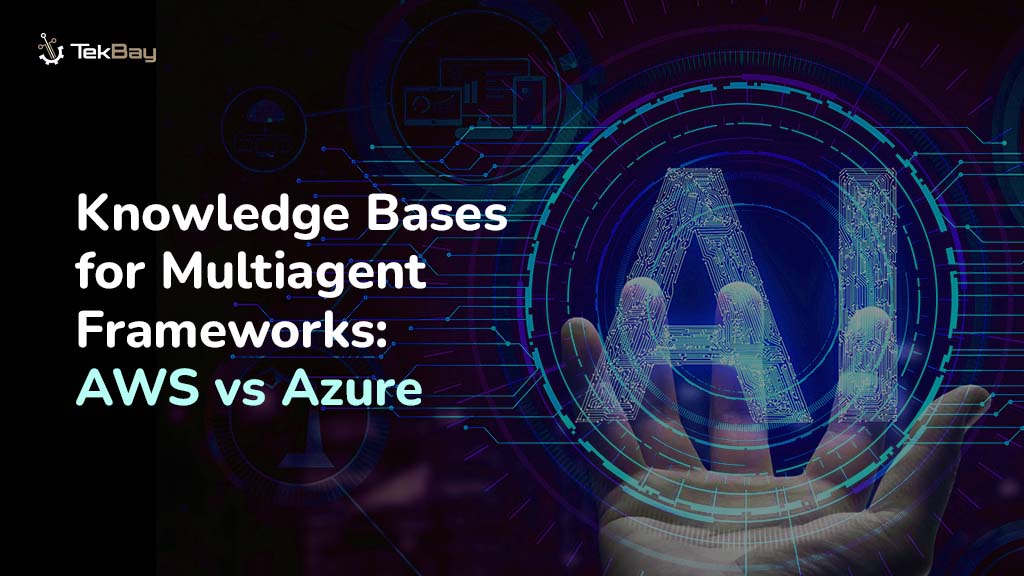
Multi-agent frameworks rely on knowledge bases for real-time data sharing and intelligent decision-making. To build such knowledge bases, AWS and Azure each offer powerful AI-driven services—Amazon Kendra, OpenSearch, and Azure Cognitive Search—that excel in search, natural language understanding, and seamless integration.
This article compares the strengths of AWS and Azure as knowledge bases for multi-agent frameworks, examining their core features and scalability.
Additionally, it explores how complementary third-party tools such as Pinecone or Weaviate can enhance the capabilities of AWS and Azure with specialized features such as advanced vector search and hybrid data management.
What Is A Knowledge Base? Why Is It Important For Multi-Agent Systems?
A knowledge base is an organized repository that stores facts, relationships, and rules to enable AI and multi-agent systems to retrieve information and make effective decisions quickly. It can be dynamic (learning and updating) or static (predefined).
A reliable knowledge enables agents share real-time data, consistently understand their environment, coordinate their actions, and collaborate efficiently. This shared knowledge empowers agents to communicate, learn, and adapt together, resulting in coherent and intelligent behavior across the system.
AWS Knowledge Base Services: Features, Pros, and Cons
AWS offers integrated services for building knowledge bases in multi-agent frameworks. These include Amazon Kendra for intelligent search, OpenSearch for scalable analytics, and Aurora with machine learning for relational data—each with its strengths and trade-offs.
1. Amazon Kendra
Amazon Kendra is a managed machine learning-powered search service for natural language queries. In multi-agent systems, Kendra enables agents to efficiently access domain-specific knowledge through natural language or structured queries, boosting real-time decision-making and coordination.
Key Features:
- Semantic Search: Understands intent and context, improving retrieval quality.
- Multi-Source Indexing: Integrates data from file systems, databases, websites, and APIs (e.g., S3, SharePoint).
- Incremental Learning: Continuously improves search relevance based on user/agent interactions.
- Fine-Grained Security: Provides access control integrated with AWS IAM.
Pros:
- Enables fast, precise responses in dynamic environments where agents require real-time information.
- Handles unstructured data well across distributed sources—ideal for decentralized agents.
- Minimal setup; easy to deploy and scale with growing agent activity.
Cons:
- Pricing is pay-per-query and scales with data volume, which can become costly at a massive scale.
- Designed primarily for search, not ideal for inferencing or vector similarity workloads.
2. Amazon OpenSearch Service
Amazon OpenSearch Service is a managed, Elasticsearch-compatible platform for full-text search, real-time analytics, and vector similarity. It lets multi-agent systems query diverse data types to track states and coordinate real-time behavior.
Key Features:
- Real-Time Indexing: Continuously ingests and updates knowledge from streaming sources.
- Vector Search Plugin: Supports semantic similarity and embedding-based lookups.
- Custom Ingest Pipelines: Allows data transformation and enrichment at scale.
- Integrated Dashboards: Visualize agent behavior and knowledge trends with Kibana.
Pros:
- Highly flexible for multi-modal knowledge (text, numbers, vectors).
- Open-source roots enable integration with tools like FAISS and Pinecone.
- Handles large-scale, low-latency data needs for distributed systems.
Cons:
- Requires more setup and tuning than Kendra.
- Vector search is not native; it requires additional plugins and setup.
- Less focused on natural language understanding, prioritizing raw search power.
3. Amazon Aurora with ML
A high-performance, MySQL/PostgreSQL-compatible relational database designed for structured data storage with strong consistency and ACID guarantees. Aurora integrates with AWS machine learning services, enabling multi-agent systems to manage complex workflows and incorporate predictive analytics for enhanced decision-making.
Key Features:
- Fully managed MySQL/PostgreSQL-compatible relational database with ACID compliance.
- Multi-AZ deployment ensures high availability and fault tolerance.
- Seamless integration with AWS ML services (e.g., SageMaker) for embedding predictive analytics.
- Strong security with encryption at rest/in transit and IAM access controls.
Pros:
- Reliable, consistent storage tailored for complex multi-agent workflows.
- Familiar SQL-based querying supports ease of development.
Cons:
- Not suited for unstructured or vector data workloads.
- ML capabilities rely on external AWS services, requiring expertise in model training and tuning.
- ML integration can add complexity and increase latency.
Azure Knowledge Base Services: Features, Pros, and Cons
Azure offers integrated services for multi-agent knowledge bases: AI-powered search with Azure Cognitive Search (now Azure AI Search) and advanced AI insights through Azure OpenAI Service.
1. Azure AI Search (Formerly Azure Cognitive Search)
Azure Cognitive Search is a fully managed AI-powered service that indexes diverse data sources for semantic, intent-based retrieval. It helps agents access unified, context-rich knowledge from distributed sources, enhancing coordination and real-time decisions.
Key Features:
- Semantic search with natural language understanding improves context-aware retrieval.
- Connectors for hybrid data integration across Azure Blob Storage, Cosmos DB, SQL, and more.
- AI enrichment pipelines for content extraction and enhancement.
- Role-based access control and encryption for secure data access.
Pros:
- Enables fast, accurate knowledge retrieval for multiple agents.
- Unifies diverse, distributed data sources.
- Scales elastically to handle real-time queries.
- Provides fine-grained, secure access control.
Cons:
- Limited reasoning capabilities beyond search.
- Costs rise with query volume and data size.
2. Azure OpenAI Service
A managed platform offering advanced large language models (LLMs) for natural language understanding, reasoning, and generation, enabling multi-agent systems to process complex queries, generate insights, and automate responses.
Key Features:
- Access to GPT-based LLMs for natural language understanding, generation, and reasoning.
- API-based integration enables smooth multi-agent communication.
- Built on scalable, secure Azure cloud infrastructure with compliance certifications.
Pros:
- Handles complex, unstructured queries effectively.
- Automates responses, easing agent workload.
- Easy integration with Azure services.
- Scales on demand.
Cons:
- Requires prompt tuning for best results.
- Costs can increase significantly with high query volumes.
- Considerations needed for latency and data privacy.
AWS vs Azure Knowledge Bases: Key Differences
| Aspects | AWS (Kendra, OpenSearch, Aurora ML) | Azure (Cognitive Search, OpenAI Service) |
| Primary Focus | ML-powered semantic search with structured & unstructured data | NLP-powered search + GPT-based language generation |
| Core Technologies | Kendra (semantic search), OpenSearch (full-text + vector support), Aurora ML (predictive queries) | Cognitive Search (semantic + cognitive skills), Azure OpenAI (GPT models) |
| Data Integration | S3, Aurora, OpenSearch indexes | Blob Storage, Cosmos DB, Azure SQL, external connectors |
| AI/ML Features | Semantic ranking, entity recognition, supports external vector DBs | GPT-powered generation, cognitive skills, custom model fine-tuning |
| Ecosystem Integration | Strong AWS stack integration, supports Pinecone/FAISS | Native Microsoft 365 & Azure AI integration, OpenAI API native support |
| Scalability | Highly scalable for large datasets | Global scale, multi-model DB support |
| Extensibility | Custom ranking, extensible indexes, vector plugin support | Custom cognitive pipelines, OpenAI fine-tuning |
| Pricing | Pay-per-query; costs increase with usage | Pay-for-storage and transactions; AI usage billed separately |
| Multi-Agent Benefits | Real-time semantic sharing, strong for agent knowledge coordination | Advanced NLP and conversational AI for dynamic agent interaction |
| Limitations | No native managed vector DB, relies on third-party tools | OpenAI costs can be high; Cognitive Search tuning is needed |
When to Use AWS Knowledge Base vs Azure Knowledge Base
Choosing between AWS and Azure knowledge base services depends on your multi-agent system’s requirements, data types, and existing cloud environment.
AWS Knowledge Base Services Are Best When:
- You require a scalable semantic search over unstructured or semi-structured data, such as regulatory documents or logs (use Amazon Kendra).
- Full-text search, vector similarity, and real-time analytics are essential (use OpenSearch).
- Your workload includes structured relational data with embedded ML inference (use Aurora with ML).
- You operate in an AWS-centric ecosystem and require seamless cloud-native integration.
Azure Knowledge Base Services Are Best When:
- You need semantic search with AI enrichment over hybrid Azure data sources, useful in healthcare or customer support scenarios (use Cognitive Search).
- Advanced NLP, language generation, or conversational AI capabilities are critical for automating complex queries or dialogues (use Azure OpenAI Service).
- Your environment centers on Microsoft/Azure ecosystems, gaining tighter platform integration.
- Elastic scalability and multi-region support are priorities for distributed multi-agent systems.
How Third-Party Tools Complement AWS and Azure Knowledge Bases
AWS and Azure knowledge bases offer powerful, scalable search and semantic capabilities. Yet, some advanced requirements, such as large-scale vector similarity search and hybrid data retrieval, exceed their native functionalities.
Third-party tools like Pinecone, FAISS, and Weaviate complement these platforms by filling those gaps, resulting in richer and more flexible knowledge management.
Pinecone
Pinecone is a managed vector database for real-time similarity search on high-dimensional embeddings. It works alongside AWS and Azure search services at the application layer, enabling a hybrid search approach that combines native filtering and indexing with semantic vector similarity powered by Pinecone.
FAISS
FAISS is an open-source vector similarity library designed for large-scale, high-performance nearest neighbor search. It requires self-hosting on cloud infrastructure like AWS EC2 or Azure VMs. FAISS complements native knowledge bases by offering customizable, fine-tuned vector search layers tailored to specific semantic ranking needs.
Weaviate
Weaviate is an open-source vector search engine that supports hybrid search, semantic ranking, and API-based integration with data sources like AWS S3 and Azure Blob Storage. Used alongside cloud knowledge bases, it enhances semantic search by indexing both structured and unstructured data.
Checklists When Choosing a Knowledge Base
Selecting the right knowledge base for multi-agent frameworks involves evaluating:
- Data Variety and Format: Support for structured, unstructured, and vector data ensures flexibility for different agent use cases.
- Search Capabilities: Look for native semantic search, keyword indexing, and vector similarity for accurate retrieval.
- Platform Compatibility: Seamless integration with existing AWS or Azure ecosystems reduces development friction.
- Performance and Scalability: Ensure the system can handle real-time queries and scale with growing data or agent load.
- Cost Efficiency: Choose a pricing model that aligns with your usage patterns—balancing storage, compute, and query volume.
Conclusion
Knowledge bases are essential for enabling intelligent collaboration and decision-making in multi-agent systems. AWS offers flexible, scalable semantic search through services like Amazon Kendra and OpenSearch, while Azure stands out with deep AI-driven language understanding via Cognitive Search and the OpenAI Service.
For most cases, native services suffice, though some advanced needs may benefit from complementary third-party tools. Ultimately, the best choice depends on your project’s specific requirements and how each platform’s strengths align with your multi-agent framework goals.