
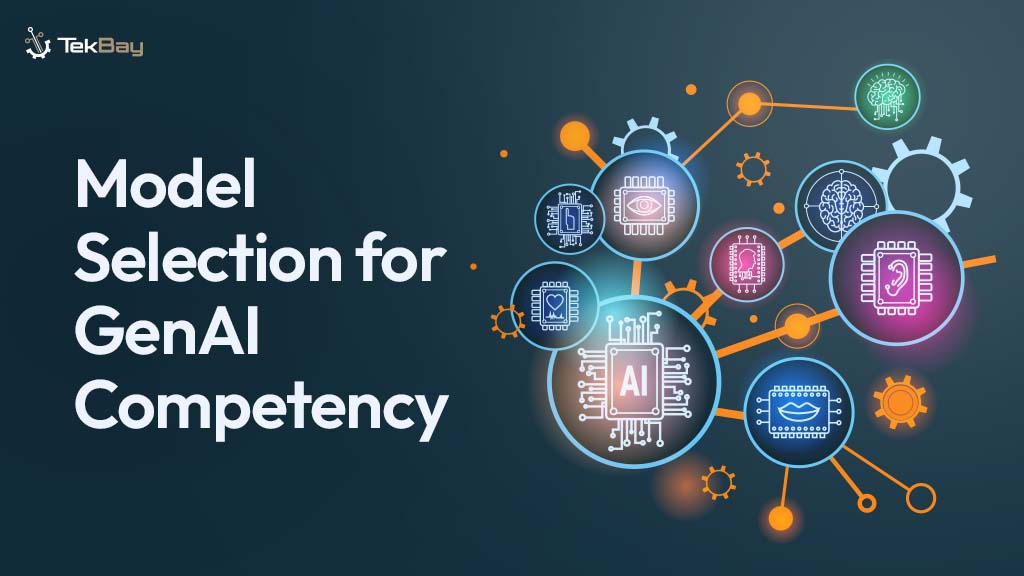
The rapid evolution of generative artificial intelligence has created both unprecedented opportunities and complex decision-making challenges for organizations. With dozens of foundation models available from GPT-4 and Claude to specialized models like Codex and DALL-E, choosing the right AI model for your specific use case has become a critical competency that can determine the success or failure of your AI initiatives.
This guide provides a structured approach to model selection that goes beyond surface-level comparisons to help you build genuine GenAI competency within your organization.
Understanding the Model Landscape
The generative AI ecosystem spans multiple modalities and architectural approaches. Large Language Models (LLMs) like GPT-4, Claude, and Gemini excel at text generation, reasoning, and complex conversational tasks.
Multimodal models such as GPT-4V and Gemini Pro Vision combine text and image understanding. Specialized models like GitHub Codex focus on code generation, while diffusion models like Stable Diffusion and DALL-E 3 create images from text descriptions.
Understanding this landscape requires recognizing that no single model excels at everything. Each represents trade-offs between capabilities, cost, speed, and specialized performance.

Strategic Framework for Model Selection
1. Define Your Use Case with Precision
Effective model selection starts with a clear understanding of your specific requirements. Instead of asking, “Which is the best AI model?”, ask, “Which model best serves our application?”
Key Dimension To Consider
- Task complexity: Are you handling simple classification, complex reasoning, or creative generation?
- Domain specificity: Do you need general knowledge or specialized expertise in fields like medicine, law, or engineering?
- Output requirements: What quality, format, and consistency standards must be met?
- Interaction patterns: Will users engage in single queries or extended conversations?
2. Evaluate Core Capabilities
Different models excel in different areas. For example:
- GPT-4: Strong reasoning and broad knowledge, but may hallucinate factual details.
- Claude: More nuanced, context-aware responses and better at following complex instructions.
- Gemini Pro: Excellent for technical tasks and coding.
Create a capability matrix mapping your requirements to model strengths. Include aspects such as reasoning ability, factual accuracy, creative writing, code generation, multilingual support, and instruction following.
3. Consider Practical Constraints
Technical and business constraints often matter more than raw capabilities. Evaluate:
- Cost structure: Pricing varies dramatically. GPT-4 is more expensive per token than GPT-3.5, while open-source alternatives like Llama 2 can save costs but require infrastructure management.
- Latency requirements: Real-time applications need fast response times. Smaller models like Claude Haiku or GPT-3.5 Turbo often provide lower latency.
- Privacy and security: Sensitive data may require on-premises deployment or models with strict data-handling guarantees. Cloud-based APIs may not be suitable for confidential information.
- Integration complexity: Consider API availability, documentation quality, and compatibility with your existing technology stack.
A Practical Decision Framework
Based on the GenAI competency model selection process, organizations can follow a structured approach to ensure the right model aligns with both immediate and long-term objectives.
Step 1: Requirements Analysis
Begin with a comprehensive analysis of your business requirements, including performance expectations, regulatory constraints, and technical specifications.
Step 2: Compliance and Licensing Assessment
Regulatory and licensing considerations often dictate which models are feasible. Map your compliance needs, such as HIPAA, SOC 2, ISO 27001, or GDPR, against available model options.
Step 3: Technical Specification Matching
Align your technical requirements with model capabilities:
- Context window needs: short vs. long context processing
- Latency requirements: real-time vs. batch processing
- Quality expectations: enterprise-grade vs. standard performance
Step 4: Resource and Capability Evaluation
Assess your organization’s technical expertise, infrastructure, and budget to determine feasible implementation strategies.
Step 5: Strategic Considerations
Consider long-term factors, including vendor lock-in risks, customization needs, and future scalability requirements.
This structured approach ensures that model selection aligns with both immediate needs and strategic objectives, creating a foundation for sustainable GenAI competency.
Advanced Considerations
Multi-Model Strategies
Sophisticated applications often benefit from leveraging multiple models. For example, you might use a powerful model like GPT-4 for complex reasoning tasks while relying on a faster, cost-efficient model for simpler queries. Some organizations implement routing systems that automatically select the most appropriate model based on query characteristics.
Consider ensemble approaches, where multiple models generate responses that are then synthesized or validated against each other. This can improve reliability and mitigate weaknesses inherent in individual models.
Fine-Tuning and Customization
Generic models may require customization for specialized domains. Fine-tuning can improve performance on specific tasks but requires expertise, data, and ongoing maintenance. Evaluate whether fine-tuning costs justify performance improvements over prompt engineering or retrieval-augmented generation approaches.
Emerging Capabilities and Future Planning
The AI landscape evolves rapidly. GPT-4 introduced multimodal capabilities that weren’t available in earlier models. New models regularly emerge with improved capabilities, better efficiency, or novel features.
Build flexibility into your architecture to accommodate model changes. Avoid tight coupling between your application logic and specific model APIs. Consider abstraction layers that allow you to swap models without major code changes.
Building Organizational Competency
Selecting the right AI model is only the first step. True organizational competency comes from embedding model evaluation and optimization into ongoing business processes. Teams should be trained to understand each model’s strengths, limitations, and ideal use cases, while feedback loops capture real-world performance to guide continuous improvement.
Strong governance frameworks are essential, balancing innovation with risk management. Define clear procedures for model updates, performance monitoring, and rollback strategies to maintain reliability.
Establishing Centers of Excellence or dedicated AI teams can help standardize best practices, guide model selection across business units, and ensure that your GenAI initiatives remain scalable, strategic, and future-ready.
Common Pitfalls to Avoid
- Relying Only on Benchmarks or Marketing Claims: Benchmarks may not reflect your specific use cases, and marketing materials often emphasize best-case scenarios.
- Neglecting Prompt Engineering: A well-crafted prompt can significantly improve performance across different models. Sometimes, prompt quality and system design matter more than the choice of model.
- Always Choosing the Most Powerful Model: Simpler models often provide better value for straightforward tasks. A properly implemented GPT-3.5 solution may outperform a poorly implemented GPT-4 system.
Measuring Success and Iterating
- Define Clear Success Metrics: Align metrics with business objectives. Focus on user satisfaction, task completion rates, and measurable business impact rather than purely technical scores like perplexity or BLEU.
- Implement Comprehensive Monitoring: Track model performance in production to detect issues early and understand real-world behavior.
- Establish Feedback Mechanisms: Capture both quantitative data and qualitative user insights to inform refinements in model selection and system design.
- Plan Regular Evaluation Cycles: The best model today may not be optimal tomorrow. Build processes for systematic reevaluation, updates, and migration to newer or better-suited models as requirements evolve.
Conclusion
Effective GenAI model selection requires balancing technical capabilities, business needs, and strategic objectives. Success comes from systematically matching models to specific use cases rather than chasing the “best” model in abstract terms.
Organizations that build processes and expertise for ongoing evaluation and optimization will gain a competitive advantage, adapt quickly to new opportunities, and avoid costly mistakes. By focusing on outcomes and maintaining flexibility, businesses can develop the GenAI competency needed to thrive in an AI-driven future.