
Xcatter is a rapidly expanding e-commerce company specializing in promotional events and flash sales of high-demand products. Managing sudden traffic surges is crucial for maintaining seamless operations and capitalizing on business growth opportunities. During peak shopping season, the influx of visitors can be overwhelming. Hence, uptime is vital as it directly affects customer experience and satisfaction.
The client faced critical operational challenges due to the unpredictable behavior of their EC2 instances. Frequent production outages, caused by configuration inconsistencies and network issues, resulted in substantial revenue loss.
This case study explores how TekBay’s comprehensive solution profoundly impacted Xcatter’s operations. It led to significant improvements in EC2 instance management, ensuring consistency and rapid recovery of environments, thereby reducing downtime.
Key Challenges: Mastering EC2 Complexity
Frequent production incidents resulted in extended downtime and revenue losses, which disrupted service continuity, particularly during peak demand periods. For example:
- Configuration Error: Misconfiguration pushed to the wrong server went unnoticed, leading to a three-hour service outage
- Network Security Policy: The new security policy misconfigurations prevented new EC2 instances from accessing the external Yum repository, leading to capacity shortages and system failures. A prime example of this was the website not functioning during a crucial sales campaign.
- Environment Inconsistency: Differences between QA and production environments hindered troubleshooting and resolution times
TekBay Solution: Building a Resilient EC2 Infrastructure
To ensure consistent, secure, and rapidly deployable infrastructure, we implemented an Amazon Machine Image (AMI)- based deployment strategy leveraging AWS CodePipeline and Packer.
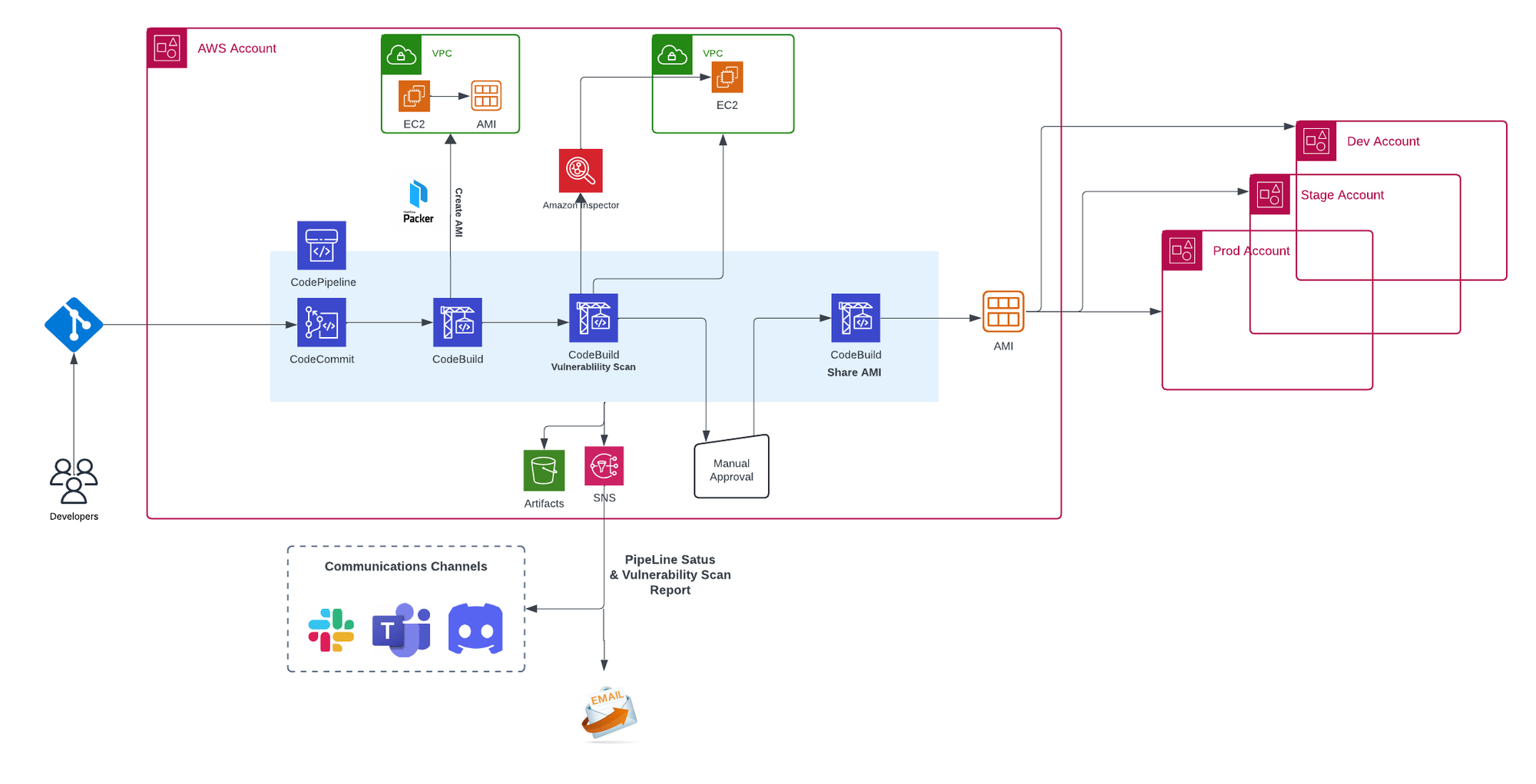
- Immutable Image Creation: The infrastructure deployment strategy will be AMI-based and leverage AWS CodePipeline. The solution implements Packer to create immutable AMIs in the CodePipeline build stage, guaranteeing consistent environments across deployments.
- Security Validation: Newly created AMIs undergo rigorous security scanning using AWS Inspector with AWS-managed rules packages like Common Vulnerabilities and Exposures (CVEs) at the pipeline process.
- Conditional Deployment: If security scans identify vulnerabilities, the pipeline is paused for manual approval after notification via SNS to relevant stakeholders. Upon remediation and retesting, the pipeline resumes
Benefits
Implementing immutable AMIs and continuous security validation yielded tangible benefits for them, including increased consistency, accelerated recovery, and enhanced security.
- Consistency: Immutable AMIs ensure identical instances across environments, eliminating configuration drift and accelerating recovery times.
- Strengthened Security Posture: Proactive vulnerability management with Amazon Inspector identified and remediated vulnerabilities before deployment.
- Improved efficiency and productivity: Automated deployment pipelines streamlined operations, reduced human error, and accelerated time-to-market.
- Measurable Impact: A substantial 80-90% reduction in configuration errors led to fewer production incidents and downtime.
Results
- Configuration Errors: Reduced by 90%, leading to fewer production incidents.
- Recovery Time: Decreased from hours to an average of 30 minutes during high-traffic events.
- Uptime: Achieved 99.9% uptime during critical flash sales, minimizing revenue losses.
- Security: 100% remediation of vulnerabilities through automated scans before deployment.
- Deployment Efficiency: Reduced manual intervention by 85% with automated CI/CD pipelines.
Conclusion:
The integrated use of AWS CodePipeline, HashiCorp Packer, Terraform, and Amazon Inspector has enabled Xcatter to create a highly resilient and secure infrastructure. This approach ensured a consistent, reliable, and secure deployable environment, ultimately improving operational efficiency and minimizing downtime to effectively manage high-traffic events.